
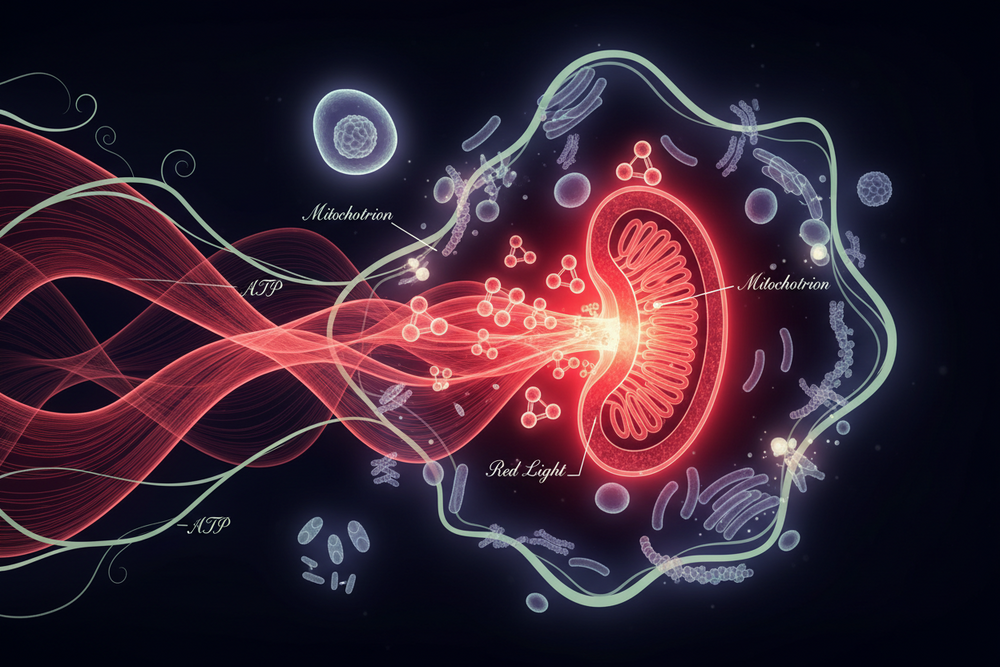
When exploring the frontiers of modern cellular recovery, few modalities rival the biological impact of Red Light Therapy. Often referred to clinically as Photobiomodulation (PBM), this non-invasive intervention delivers specific wavelengths of photon energy directly to cell receptors, triggering a cascade of beneficial biochemical processes.
## 01 / The Mitochondrial Engine: Cytochrome c Oxidase
At the core of red and near-infrared (NIR) light therapy is the mitochondria—the powerhouses of our cells. Within the mitochondrial respiratory chain sits a key photo-receptive copper enzyme known as **Cytochrome c Oxidase (CcO)**.
During periods of cellular stress, intense athletic training, or inflammation, nitric oxide (NO) binds to Cytochrome c Oxidase, displacing oxygen and effectively bottlenecking cellular respiration. This halts the production of **Adenosine Triphosphate (ATP)**, the fundamental energy currency of human cells.
When you expose targeted muscle tissue to high-density red wavelengths, a profound displacement occurs:
1. **Photon Absorption**: Mitochondria absorb light photons between the ranges of **660nm** (red) and **850nm** (near-infrared).
2. **Nitric Oxide Dissociation**: The absorbed light breaks the bond between nitric oxide and Cytochrome c Oxidase.
3. **Oxygen Binding**: Oxygen binds back to CcO, allowing the cellular respiration cycle to resume at peak efficiency.
4. **ATP Surge**: ATP synthesis spikes, supplying cells with the fuel needed to repair micro-tears, reduce inflammatory markers, and accelerate recovery.
## 02 / The Spectral Split: 660nm vs. 850nm Wavelengths
Not all light waves penetrate the body at equal depths. Our optimized clinical setups leverage a precise dual-spectrum delivery:
### The Red Spectrum (660nm)
Wavelengths at **660nm** are absorbed heavily by skin tissue and superficial muscle layers. This range is highly effective for:
* Promoting collagen synthesis and skin elasticity.
* Healing micro-abrasions and minor surface inflammation.
* Accelerating superficial wound recovery.
### The Near-Infrared Spectrum (850nm)
Wavelengths at **850nm** have a much deeper biological penetration footprint, bypassing skin cells to reach deep muscle tissue, joints, and bone structures. This range is critical for:
* Alleviating deep-tissue muscle soreness and joint inflammation.
* Speeding up myofibrillar protein synthesis after heavy resistance training.
* Enhancing blood circulation in deep vascular pathways.
## 03 / Engineering Irradiance: Choosing Your Recovery Grid
To achieve true photobiomodulation, tissue must be exposed to sufficient **irradiance** (light power density). Simple low-wattage bulbs or weak LED strips lack the photon density required to stimulate deep-seated Cytochrome c Oxidase enzymes.
Our professional series panels are engineered to solve this limitation:
* **High-Density Wavelength Delivery**: Emits a targeted blend of 660nm and 850nm photons.
* **Irradiance Output**: Measured at over **100 mW/cm²** at a distance of 6 inches, ensuring clinical-grade energy penetrates the skin barrier.
* **Flicker-Free Driver Circuits**: Maintains stable, non-pulsing current to prevent neural strain and maximize eye safety.
By integrating structured, high-output red light sessions into your daily recovery routine, you bypass the typical biological bottlenecks of fatigue and soreness, feeding your cells the exact wavelengths they need to synthesize energy and perform at their peak.